

Disclosure: This post contains affiliate links. As an Amazon Associate, ToolUnbox earns from qualifying purchases, at no extra cost to you. How we earn money.
The best orbital sander for most home shops is the DEWALT 20V MAX (DCW210B), a cordless 5-inch random orbit model with a brushless motor and a speed dial that runs from 8,000 to 12,000 OPM. It is also the shortest and lowest body in this group, at 8.81 inches long and 5.75 inches tall. That makes it easy to carry anywhere and easy to tuck inside a cabinet.
It isn’t the strongest sander here, though. If you sand big tabletops next to an outlet all afternoon, the corded Makita BO5041K has a wider speed range and a calmer reputation among owners.
I compared five 5-inch random orbit sanders from DEWALT and Makita. Two are cordless and three plug in. Here’s the short list first, then the details.
Best Orbital Sander Picks at a Glance
| # | Product | Best For | Power | Speed (OPM) | Link |
|---|---|---|---|---|---|
| 1 | DEWALT 20V MAX DCW210B | Cordless work in tight spots | 20V brushless, battery sold separately | 8,000 to 12,000, variable | Check Price |
| 2 | Makita XOB01Z 18V LXT | Makita battery owners | 18V LXT, battery sold separately | 7,000 / 9,500 / 11,000 | Check Price |
| 3 | Makita BO5041K | Long sessions on big flat surfaces | 3.0 amp corded | 4,000 to 12,000, variable | Check Price |
| 4 | DEWALT DWE6423K | Corded kit with a carry bag | 3.0 amp corded | 8,000 to 12,000, variable | Check Price |
| 5 | DEWALT DWE6421 | Simple rough sanding | 3.0 amp corded | 12,000, fixed | Check Price |
How I Picked These Sanders
I didn’t run these sanders on a bench. When I compared them, I worked from spec sheets, manufacturer descriptions and Amazon listings, then read through owner feedback for patterns that repeat across many buyers. You can read more about how we review products.
Each sander was judged on five things: sanding power, speed control, vibration and comfort, cordless freedom, and reach. Power carried the most weight, because a sander that bogs down under pressure wastes your afternoon. As an Amazon Associate, ToolUnbox earns from qualifying purchases, and that has no effect on the order.
Two listings had no owner feedback to read. Both are corded DEWALTs, so for those I lean on the spec sheet and say so.
The 5 Best Orbital Sanders
1. DEWALT 20V MAX Orbital Sander (DCW210B): Best Overall

DEWALT 20V MAX Orbital Sander DCW210B
Best for: Cordless sanding in cabinets, along trim and in tight corners
Check Price on AmazonThis is the sander I’d hand to most people. A brushless motor drives a 5-inch hook-and-loop pad, and a dial sets the speed anywhere from 8,000 to 12,000 orbits per minute. At 2.5 pounds and 5.75 inches tall, it’s the lightest and lowest tool in this roundup.
Low height matters more than it sounds. A shorter body puts your hand closer to the wood, so you feel the surface and can steer into corners. DEWALT also seals the switch against dust, which is where cheap sanders tend to give out first.
Owner feedback is mostly about convenience. Many buyers already own DEWALT 20V batteries and like sharing them across tools, though a few say it feels slower than their corded sander when stripping lots of material.
Some owners also report the dust bag coming loose. You can skip the bag and run a hose to a DEWALT DWV010 or DWV012 dust extractor, which the listing names as compatible.
Pros
- Variable speed from 8,000 to 12,000 OPM
- Shortest (8.81 inches) and lowest (5.75 inches) body in the group
- Brushless motor and a dust-sealed switch
- Shares 20V MAX batteries with other DEWALT tools
Cons
- Sold as a bare tool, so the battery and charger cost extra
- Several owners find the dust bag loose
- Trails a corded sander on heavy stock removal, per owners
Skip this one if you don’t own DEWALT 20V batteries and always sand near an outlet.
2. Makita XOB01Z 18V LXT Random Orbit Sander: Best for Makita Owners

Makita XOB01Z 18V LXT Cordless Random Orbit Sander
Best for: Makita LXT owners who want a cordless 5-inch sander
Check Price on AmazonThe Makita handles speed differently. Instead of a dial, a one-touch electronic switch picks low, medium or high: 7,000, 9,500 or 11,000 OPM. Presets are easy to repeat from job to job, but you lose the steps in between.
On paper, the sanding action is aggressive. Makita lists a 1/8-inch random orbit, a pad brake that cuts free-spin, and a control system that regulates pad speed at start-up. The company also claims up to 40 minutes of run time per charge.
Owner feedback splits in a useful way. People with big Makita kits call it an easy choice and praise the runtime, while others say it can’t match a corded sander for speed and may slow down once the battery drops past half.
A few owners with medium-sized hands find the grip and button placement awkward. That’s worth knowing if you plan long sessions.
Pros
- Three electronic speeds: 7,000, 9,500 and 11,000 OPM
- 1/8-inch orbit for faster material removal
- Pad brake and soft-start speed control
- Up to 40 minutes per charge, according to Makita
Cons
- No low-profile design, so reach trails the DEWALT
- Battery and charger sold separately
- Some owners report a slowdown at half battery
Skip this one if you’re not already invested in Makita’s 18V LXT platform.
3. Makita BO5041K Random Orbit Sander: Smoothest Corded Pick

Makita BO5041K 5-Inch Random Orbit Sander
Best for: Long sanding sessions on tabletops and large flat panels
Check Price on AmazonJudged on sanding alone, this Makita would win. It pairs a 3.0 amp motor with the widest speed dial here (4,000 to 12,000 OPM) and an adjustable front handle for two-hand control. Makita also lists oversized sealed ball bearings for longer tool life.
Owners keep coming back to how calm it feels. The recurring themes are low vibration at every speed, quiet running on the lower settings, and comfort that even buyers with arthritis mention. One owner describes stripping finish off a dozen restaurant tables in one long day on top speed.
So why third? It’s corded, and its conventional body sits taller than the DEWALTs. A couple of owners also call the dust collection a little weak and the lock-on button oddly placed.
Pros
- Widest speed range: 4,000 to 12,000 OPM
- 3.0 amp motor with a 1/8-inch orbit
- Adjustable front handle and rubberized palm grip
- Owners consistently report low vibration and low noise
- Comes with a case
Cons
- Corded only
- Dust collection is average, according to some owners
- Taller body limits reach inside cabinets
Skip this one if you sand on job sites without power or mostly work inside cabinets.
4. DEWALT DWE6423K Orbital Sander Kit: Best All-Around Kit

DEWALT DWE6423K Variable Speed Orbital Sander Kit
Best for: Corded variable speed sanding with a carry bag included
Check Price on AmazonThink of this as the corded cousin of the top pick. It runs a 3.0 amp motor at 8,000 to 12,000 OPM, uses a separate counterweight to cut vibration, and has a shorter body that brings your hand closer to the work. The box holds the sander, a one-handed locking dust bag and a carrying bag.
DEWALT backs it with a 3-year limited warranty. It measures 10.38 inches long and 6.2 inches tall, and like the cordless model it can feed straight into a DWV010 or DWV012 dust extractor.
I found no owner feedback attached to this listing, so I’m judging it on the spec sheet alone. The specs are solid. I just can’t tell you how the switch or dust bag hold up after a year.
Pros
- Variable speed from 8,000 to 12,000 OPM
- Counterweight and rubber overmold for comfort
- Carrying bag and dust bag included
- 3-year limited warranty
Cons
- Corded, so you need an outlet nearby
- No owner feedback available to confirm long-term durability
Skip this one if you often work far from power.
5. DEWALT DWE6421 Palm Sander: Best Simple One-Speed Pick
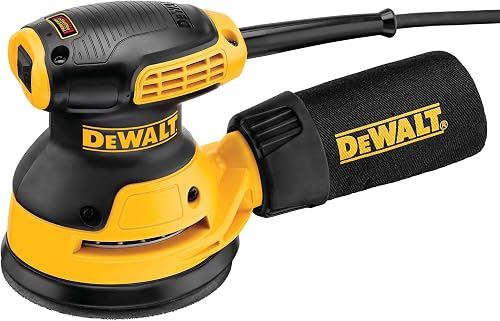
DEWALT DWE6421 5-Inch Random Orbit Palm Sander
Best for: Rough sanding jobs where one fast speed is enough
Check Price on AmazonThis shares a lot with the DWE6423K: the same 3.0 amp motor, counterweight, rubber overmold and short body. The big difference is speed. It runs at a single fixed 12,000 OPM, with no dial at all.
For stripping old finish or knocking down rough boards, one fast speed is fine. For veneer, end grain or light passes between coats of finish, the lack of a slow setting hurts. It weighs 3.4 pounds, measures 10.31 inches long, and carries the same 3-year limited warranty.
Like the kit, this listing had no owner feedback for me to read. Treat it as a spec-sheet pick.
Pros
- Simple: one switch, one speed
- Counterweight design for lower vibration
- Dust bag included
- 3-year limited warranty
Cons
- Fixed 12,000 OPM, so no gentle finishing speed
- Corded
- No carrying bag in the box
Skip this one if you do a lot of delicate finishing work.
Which Orbital Sander Should You Buy?
- If you need to sand anywhere, or inside cabinets and along trim, get the DEWALT 20V MAX DCW210B.
- If your shelf already holds Makita 18V LXT batteries, get the Makita XOB01Z.
- If you sand large flat surfaces like tabletops or deck boards for hours, get the Makita BO5041K.
- If you finish delicate wood or polish and want a gentle, controllable speed, the Makita BO5041K is also the answer. Its dial drops to 4,000 OPM.
- If long sessions tire your hands, look at the Makita BO5041K or the counterweighted DEWALT DWE6423K.
- If you want corded power, variable speed and a carry bag in one box, get the DEWALT DWE6423K.
- If you only do rough sanding and want the simplest tool, the DEWALT DWE6421 does the job.
Still building out your shop? Our power tools hub has more picks, and the best socket set guide covers the wrench side of the bench.
What to Look for in an Orbital Sander
Sanding Power
Corded sanders list amps. All three corded picks here use a 3.0 amp motor, so the differences come down to orbit size and speed range. Cordless models list voltage and motor type instead.
My take: owners of both cordless picks say they still trail a corded sander on heavy removal. If you strip whole tables often, plug in.
Speed Control
You’ll see three setups. A variable dial (DCW210B, BO5041K, DWE6423K) lets you creep up from a low speed, while three electronic presets (XOB01Z) are easy to repeat. A fixed speed (DWE6421) is the simplest and the least flexible.
The low end matters most. The BO5041K starts at 4,000 OPM, while the DEWALT dials bottom out at 8,000.
Vibration and Comfort
Look for a counterweight, a rubber overmold where your palm sits, and a weight you can hold for an hour. The tools here range from 2.5 pounds (DCW210B) to 3.4 pounds (DWE6421). Grip size is personal, so if you have small or medium hands, read owner comments on button placement.
Cordless Freedom
Both cordless sanders ship as bare tools. That’s fine if you own the battery platform and pricey if you don’t. Makita claims up to 40 minutes per charge on the XOB01Z, while the DCW210B listing gives no runtime figure.
Reach and Profile
Height decides how close your hand sits to the work. The DCW210B is 5.75 inches tall, the DWE6421 is 6 inches, and the DWE6423K is 6.2 inches. The Makita listings show 12-inch dimensions on every side, which looks like box size, so I couldn’t compare them directly.
Dust Collection
Most of these listings include a dust bag, and most use hook-and-loop paper that swaps in seconds. Owners complain about bags more than anything else. A hose to a shop vacuum or dust extractor beats any bag.
Sanding Technique and Safety Basics
A good sander can still leave swirl marks. Most of the time it’s technique, not the tool. Here’s the routine I’d follow:
- Start coarse, then step up. Use 80 grit to remove old finish, 120 to smooth, and 150 to 220 before stain. Don’t jump more than one grit size at a time.
- Set the pad down before you pull the trigger. Lift it only after the pad slows. This keeps the edge from digging in.
- Let the tool do the work. Pressing hard slows the pad and leaves swirls.
- Move slowly. About an inch per second, with each pass overlapping the last by half.
- Change paper when it clogs. Loaded paper burnishes wood instead of cutting it.
- Wipe between grits. Leftover coarse grit will scratch your finer pass.
Now the safety part. Fine wood dust irritates lungs and eyes, so wear a dust mask or respirator and safety glasses, and add hearing protection for long sessions. Connecting a vacuum helps a lot.
Old paint is a bigger concern. Homes built before 1978 may have lead-based paint, and power sanding it spreads lead dust through the house. Test first, and read the EPA’s lead guidance before you sand any painted trim or furniture of unknown age.
Frequently Asked Questions
Is a Random Orbital Sander the Same as an Orbital Sander?
Mostly, yes. Nearly every 5-inch “orbital sander” sold today, including all five here, is a random orbit sander with a round hook-and-loop pad. The pad spins and moves in small offset loops at once, which hides swirl marks. Older sheet sanders use a square pad and clamped paper.
Is a Cordless or Corded Orbital Sander Better?
Corded is better for long sessions and heavy removal, since owners of both cordless picks say they trail corded tools on speed. Cordless is better for portability, quick jobs and tight spaces. If you already own a battery platform, the cordless option costs less to add.
What Does OPM Mean on a Sander?
OPM stands for orbits per minute, the number of small loops the pad makes each minute. Higher OPM removes material faster. Lower OPM gives you more control for finishing, polishing and thin veneer.
Do Cordless Orbital Sanders Come With a Battery?
Not these two. The DEWALT DCW210B and Makita XOB01Z are both sold as tool only, with the battery and charger sold separately. Budget for them if you don’t already own the platform.
What Grit Should I Start With on an Orbital Sander?
Start with 80 grit to remove old finish or level rough boards. Move to 120 for smoothing, then 150 to 220 before staining or finishing. On wood that’s already smooth, you can start at 120.
Can I Connect an Orbital Sander to a Shop Vac?
Yes, in most cases. The DEWALT listings name the DWV010 and DWV012 dust extractors as direct fits. The Makita listings don’t name a matching extractor, so check the port size before buying an adapter.
Last updated: November 2026